



Getting bed height right sits somewhere between an afterthought and a decision most people only regret after they've already bought. Pick a frame that's too low and you're grinding your joints every morning. Too high and getting in feels like a minor act of athleticism. Get it right and you won't think about it at all — which is exactly the point.
This guide goes further than the usual "24 inches is standard" advice. We'll cover how to work out your ideal height based on your body, how your mattress thickness changes the calculation, what to do if you share a bed with someone significantly taller or shorter than you, and how to adjust what you've already got without replacing everything.
What actually determines bed height?
Before you can pick the right height, it helps to understand what creates it. Your total bed height is the sum of three components:
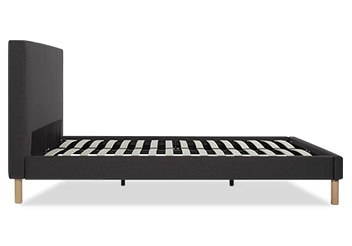
The bed frame — typically 15–45cm from floor to the top of the slats. Divan bases and ottoman frames tend to sit higher because of the storage mechanism. Low platform frames sit much closer to the floor.
The mattress — OTTY mattresses range from around 25cm (Aura) to 30cm (Pure+). Thicker mattresses add meaningful height to any frame setup.
A mattress topper — if you're using one, add another 5–8cm. The OTTY bamboo charcoal topper adds around 5cm.
Most guides quote "24 inches" (about 61cm) as standard total height. That's a reasonable midpoint, but for taller people, shorter people, those with joint conditions, or anyone using a particularly thick mattress on a low frame, the real number might be quite different.
The sit-test: the most reliable way to find your ideal height
The single most useful thing you can do is sit on the edge of the bed and check your position.
Your feet should rest flat on the floor. Your knees should be roughly level with your hips — not above them, not significantly below. If your knees are above your hips, the bed is too low. If your feet can't reach the floor or your knees drop noticeably below your hips, it's too high.
This position matters because it's the geometry you use every time you get in and out of bed. A bed at the wrong height doesn't just feel awkward — over time it puts repeated strain on your knees, hips, and lower back with each transition.
A rough height guide by standing height:
| Your height | Approximate ideal total bed height |
|---|---|
| Under 5'3" (160cm) | 45–55cm |
| 5'3"–5'9" (160–175cm) | 55–62cm |
| 5'9"–6'2" (175–188cm) | 60–68cm |
| Over 6'2" (188cm+) | 65–75cm |
These are starting points. The sit-test overrides any table — use your own body.
Enter your height to find your ideal total bed height range (frame + mattress combined).
Ideal total bed height
–
Approx. knee height
–
The sit-test is the most reliable check — sit on the edge of the bed with feet flat on the floor; your knees should be level with your hips.
How to calculate your total height before you buy
If you're choosing a new frame and mattress together, work backwards from your target height.
For example: you're 5'10" and want a total height of around 63cm. You've chosen the OTTY Original Hybrid (30cm). That means you need a frame with slat height of roughly 33cm. An ottoman frame or divan base typically sits at 35–40cm, which combined with that mattress puts you at 65–70cm total — comfortable for most people in that height range. A low platform frame at 15cm would give you 45cm total — fine for someone shorter, tight for someone at 5'10".
The point is: don't choose the frame and mattress independently. Treat them as a system with a target output.
Frame types and their typical heights
Low frames (floor-to-slat: 10–22cm)
These create a minimalist, contemporary look. Popular in Japandi-style bedrooms. Total height with a standard mattress usually lands between 40–52cm. Good for shorter sleepers, younger adults, and anyone who prefers the aesthetic. Not ideal if you have hip or knee problems, as you need to bend significantly to get in and out. Also limits under-bed storage.
Standard frames (floor-to-slat: 25–35cm)
The most practical range for most UK adults. Flexible enough to work with most mattress thicknesses. Total height with an OTTY mattress typically puts you in the 55–65cm range.
High frames — including ottomans and divans (floor-to-slat: 35–50cm)
These offer significant storage space underneath and suit taller people well. Ottoman frames like the OTTY Ottoman Bed Frame are built around the storage mechanism, which naturally adds height. Total height with a thicker mattress can reach 70–80cm. Good for taller adults and those who value storage, but can feel too high for shorter people or those with joint issues.
Sharing a bed: what to do when heights differ
The most common scenario: two people who aren't the same height sharing a single bed at a single height. One person's ideal might be another's compromise. If you're navigating this alongside other sleep compatibility questions, our mattress guide for couples covers the broader picture.
On height specifically, the best approach is to find the height that works for the taller person's comfort — particularly where joint health is a factor — and adapt for the shorter person if needed. A simple bedside step lets the shorter person access the bed comfortably without raising it to an uncomfortable level for the other.
If one of you has joint or mobility issues, that person's needs should lead the decision. Minor inconvenience for the other is easier to manage than a setup that's consistently problematic for the one with the health condition.
How to adjust height without replacing your bed
Bed risers: Plastic or wooden risers sit under the legs of a standard bed frame, adding 5–15cm. Cost-effective and reversible. They don't work well with divans (which typically have no legs), or with ottoman frames where the lift mechanism requires a stable, level base.
Mattress topper: Adding a 5–8cm topper is a simple way to raise total height while also improving comfort. Worth considering if you're on the borderline between comfortable and slightly too low.
Removing the topper: If your bed is too high and you have an existing topper you're not committed to, removing it immediately drops 5–8cm with no cost.
Switching the mattress: A genuine height issue — rather than a comfort issue — can sometimes be resolved by choosing a mattress of different depth. If you're on a low frame and need more height, stepping up from a 25cm to a 30cm mattress is more elegant than adding bed risers.
Box spring removal: Less common in the UK than the US, but if you have a divan setup with a separate box spring layer, removing it can drop total height by 15–20cm.
Bed height and specific health conditions
Knee problems: A bed that's too low forces deep knee flexion every time you sit down or stand up. A slightly higher bed (65–70cm total) reduces this strain considerably.
Hip replacements or hip pain: Low beds are particularly problematic here. After hip replacement surgery, you're typically advised to avoid bending the hip past 90 degrees — a low bed makes this almost impossible to avoid. Orthopaedic guidance usually recommends a bed height where the top of the mattress sits roughly at mid-thigh height when standing.
Lower back pain: There's no single ideal height for back pain — it depends on what's causing it. Generally, a bed at the right height for your sit-test position reduces the risk of strain when transitioning in and out. If you're waking with increased back pain, it's worth checking whether your current height is forcing awkward movements.
Older adults: The consistent recommendation from physiotherapy and occupational therapy guidance is to aim for total bed height around knee height when standing. This allows a more controlled sit-down and a smoother stand-up without having to push hard off the mattress. If your current setup is too low, bed risers are a simple interim solution — though they don't suit all frame types.
For anyone choosing a mattress alongside a frame to address joint issues, our guide to mattresses for joint pain and arthritis covers what to look for in the mattress itself.
Summary
The right bed height isn't a fixed number — it's the intersection of your height, your health needs, your mattress thickness, and your frame choice. The sit-test (feet flat, knees level with hips) is the most reliable calibration tool you have, and it costs nothing.
If you're building a new setup, work out your target total height first, then reverse-engineer the frame and mattress combination that delivers it. If you're adjusting an existing setup, our guide on how to make your bed and mattress more comfortable covers further options beyond height alone.

Written By: Michal Szlas
Michal Szlas is the founder of OTTY Sleep and a lifelong sports enthusiast who understands the critical role quality sleep plays in recovery and performance. With his extensive background in sports and passion for optimizing sleep, Michal is a trusted authority dedicated to helping you achieve better, more restorative sleep every night.